Table of Contents
- What Is PEP and Why the 72-Hour Window Matters
- How PEP Works: Antiretroviral Medication to Stop HIV
- Emergency HIV Prevention in Miami-Dade and Broward
- What Happens During Your First Visit
- PEP vs PrEP Explained: Which One Do You Need
- The 28-Day Course: What to Expect and How to Stay on Track
- After PEP: Moving to PrEP for Long-Term Protection
- Confidentiality, Cost, and Your Questions Answered
- Find a Clinic and Get Started
- Frequently Asked Questions
Last Updated: October 4, 2026
PEP After Exposure in Miami: Act Within 72 Hours
Resumen en español: PEP (profilaxis post-exposición) es un medicamento de emergencia que detiene el VIH después de una posible exposición. Debes comenzar dentro de 72 horas. Encuentra clínicas en Miami-Dade y Broward que ofrecen PEP el mismo día.
What Is PEP and Why the 72-Hour Window Matters
Post-exposure prophylaxis (PEP) is emergency medication you take after a possible HIV exposure to stop the virus from taking hold. PEP after exposure must start within 72 hours (the CDC). After that window closes, PEP no longer works.
Quick Answer:
- PEP must start within 72 hours of exposure
- It's a 28-day course of antiretroviral pills
- Effectiveness drops sharply after 72 hours
- It's not a one-time shot, it requires daily pills for a month
How PEP Works: Antiretroviral Medication to Stop HIV
PEP uses the same antiretroviral drugs that treat HIV, but for prevention instead of treatment. It blocks enzymes HIV needs to copy and integrate into your cells. Starting within 2 hours gives the strongest protection; it still works at 72 hours, but the window is closing.
You'll take two or three antiretroviral drugs daily for 28 days (the CDC). Missing doses weakens protection.
Emergency HIV Prevention in Miami-Dade and Broward
You don't need an appointment. Walk into an emergency department (open 24/7), urgent care, or a RapidTesting Miami partner clinic. Tell them you had a potential HIV exposure and need PEP.
Where to Go Right Now
Downtown Miami and Brickell (33130, 33131, 33129):
- Elite Wellness Club, 28 W Flagler St Ste 550, Downtown. Rapid HIV, full STD panel, PEP consultation. Walk-ins welcome. Call 855-560-2280 or visit /clinics/elite-wellness-club.
North Miami (33161, 33179):
- MJD Wellness, 822 NE 125th St Ste 103, North Miami. Same-day PEP, rapid HIV, full STD panel. Walk-ins accepted. Call 855-560-2280 or visit /clinics/mjd-wellness.
- Anuvia Medical Center, 190 NE 199th St #201, North Miami 33179. PEP and rapid testing. Call 855-560-2280 or visit /clinics/anuvia-medical-center.
Kendall and West Kendall (33193, 33186):
- Miracles of the Heart, 15668 SW 72nd St, Kendall West. Rapid HIV, PEP, STD testing and treatment. Walk-ins welcome. Call 855-560-2280 or visit /clinics/miracles-of-the-heart.
Broward (Miramar, Pembroke Pines, Hollywood):
- First Class OBGYN, 1951 SW 172nd Ave Ste 212, Miramar 33029. Same-day PEP start after rapid negative HIV test. Call 954-507-4494 or visit /clinics/first-class-obgyn.
All RapidTesting Miami partner clinics: Accept walk-ins, provide same-day results, offer English and Spanish services, and are free or low-cost. Book online or call 855-560-2280. If no partner clinic is nearby, go to the nearest emergency department.
What to Tell the Doctor
Be direct. Say: "I had a potential HIV exposure and need PEP."
Tell them:
- When the exposure happened (hours or days ago)
- What kind of exposure (sexual contact, needlestick, etc.)
- Whether you know the other person's HIV status
- Any other relevant health details
Providers don't judge. They hear this regularly. Your job is to get started fast.
What Happens During Your First Visit
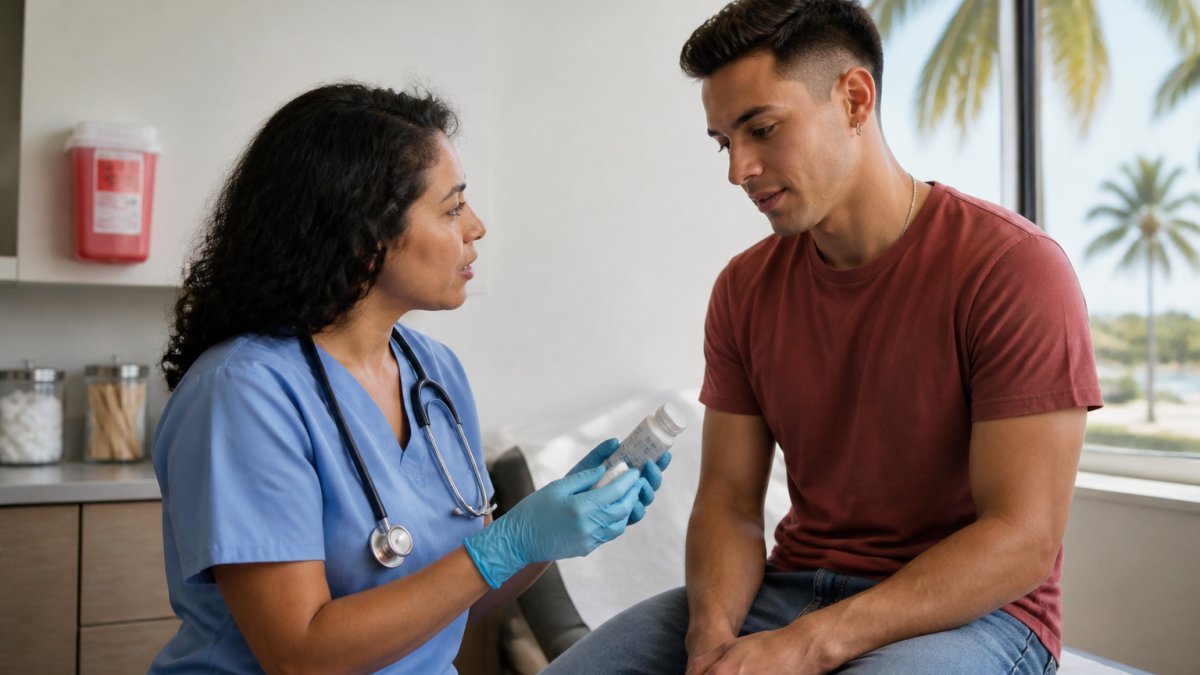
Your first visit is fast. The goal is to confirm you're HIV-negative and start PEP the same day if you are.
The Rapid HIV Test
You'll get a rapid HIV test first. This test uses a finger-stick blood sample or oral swab and gives results in 15-30 minutes. A rapid negative result means you can start PEP immediately, you do not have to wait for lab confirmation.
If the rapid test is positive or inconclusive, your provider will discuss next steps with you. A reactive rapid test is not a diagnosis until confirmed by a lab test. Your provider will order a confirmatory lab test and may still start you on PEP while waiting for results, depending on your exposure and the clinician's assessment.
Baseline Labs and What They Check
After the rapid test, the clinic will draw blood for baseline tests: HIV lab (4th-generation antigen/antibody), kidney function, liver function, hepatitis B and C screening, full STI panel (chlamydia, gonorrhea, syphilis, trichomonas), and pregnancy test if relevant. Results come back in 1-3 days. You do not wait for lab confirmation to start PEP if your rapid test was negative.
What If a Baseline Test Is Abnormal?
Abnormal results don't stop you from starting PEP the same day. Your provider will adjust your regimen or refer you to a specialist as needed. If you test positive for an STI, you'll start treatment at the same visit.
Your PEP Prescription
Once the rapid HIV test is negative and your provider has reviewed your health history and baseline labs, you'll get a prescription for a 28-day course of PEP. The most common regimen is two or three antiretroviral drugs taken once or twice daily.
Your provider will explain how to take each pill, discuss side effects, and schedule your follow-up before you leave. Take your first dose at home, then continue daily for 28 days at the same time.
Timeline: What to Expect
| Timing | What Happens |
|---|---|
| Day 0 (today) | Rapid HIV test (15-30 min), blood draw for baseline labs, STI testing, PEP prescription, first dose |
| Day 1-6 | Take PEP daily; baseline lab results return |
| Day 7 | Follow-up visit: check side effects, confirm adherence, address concerns |
| Day 8-27 | Continue PEP daily |
| Day 28 | Final visit: final HIV test, discuss PrEP or other next steps |
| Day 45 | Lab confirmation of day 28 HIV test (if needed) |
PEP vs PrEP Explained: Which One Do You Need
PEP and PrEP are both HIV prevention, but they work in different timelines.
PEP is emergency medicine after exposure (72-hour window, 28-day course). PrEP is ongoing prevention before exposure (daily pill or injection every 2 months).
PEP vs PrEP at a glance:
| Aspect | PEP | PrEP |
|---|---|---|
| When to use | After exposure (emergency) | Before exposure (ongoing) |
| Time to start | Within 72 hours | Anytime |
| Duration | 28 days | Months or years |
| How often | Daily pill | Daily pill OR injection every 2 months |
| Best for | Single exposures, emergencies | People with ongoing risk |
If you just used PEP, ask your provider about moving to PrEP. Many people who needed PEP once benefit from long-term prevention.
The 28-Day Course: What to Expect and How to Stay on Track
Taking PEP means 28 days of daily medication. Missing doses weakens protection. Most people complete the course successfully when they know what to expect and have a plan.
Common Side Effects and How to Manage Them
Side effects are common but usually mild and temporary. The most frequent ones fade within the first 1-2 weeks.
Nausea: Most common. Take your pill with food. Tell your provider if severe, they can adjust timing or prescribe anti-nausea medication. Headache: Usually mild; over-the-counter pain relievers are safe. Fatigue or dizziness: Common in the first week; call if severe. Diarrhea or stomach upset: Take with food and stay hydrated. Rash: Rare; do not stop PEP without calling your clinic. Mood changes or trouble sleeping: Usually settles after a week or two.
Staying on Track: Practical Tips
Missing doses is the biggest threat to PEP's effectiveness. Here's how to stay consistent:
- Set a daily alarm for the same time every day (breakfast, dinner, or bedtime).
- Keep pills visible by your toothbrush, coffee maker, or bed.
- Use a pill organizer to track doses at a glance.
- Tell someone you trust to remind you. You don't need to share details.
- Plan for travel: Bring enough pills and adjust your alarm if needed.
- If you miss a dose: Take it as soon as you remember. If it's almost time for your next dose (within 2-3 hours), skip the missed one. Do not double up. If you miss an entire day, call your clinic.
Follow-Up Visits During the 28 Days
Your clinic will schedule a check-in to ask how you're tolerating the medication, check adherence, address side effects, and confirm you have enough pills. Do not skip this visit.
At day 28, you'll return for a final HIV test and to discuss next steps. If you're at ongoing risk, this is when to talk about PrEP as a longer-term option.
After PEP: Moving to PrEP for Long-Term Protection
When your 28-day PEP course ends, you'll get a final HIV test. If you're at ongoing risk, talk with your provider about PrEP for long-term protection.
Two PrEP options:
Daily pill: One tablet every day of generic or brand-name emtricitabine/tenofovir. Injection: Cabotegravir every 2 months or lenacapavir every 6 months.
Starting PrEP requires a negative HIV test within 7 days, baseline labs, and an STI screen. Under the ACA, PrEP and required visits and labs are free or low-cost with most insurance when billed as preventive care. Uninsured patients have assistance programs. Many partner clinics offer telehealth PrEP visits followed by a quick lab stop. Booking your next visit before you leave is the single best way to stay protected.
Confidentiality, Cost, and Your Questions Answered
Privacy: Your clinic records are protected by HIPAA. Results are shared through your patient portal, not by text. RapidTesting Miami collects only a phone number for matching. Text STOP to opt out anytime. Cost: Many partner clinics offer free or low-cost PEP through public health programs and sliding-fee scales. Check with the clinic about your situation.
This is health information, not medical advice. Talk with a clinician about your exposure and whether PEP is right for you. If you're having a medical emergency, call 911.
Find a Clinic and Get Started
You have 72 hours. Don't wait.
Use RapidTesting Miami's Find a Clinic tool at rapidtestingmiami.com to locate the nearest partner clinic by zip code. You can also call 855-560-2280 to speak with someone right away.
All partner clinics accept walk-ins, offer same-day results, and provide services in English and Spanish. PEP is free or low-cost.
If you're in an emergency situation or it's after hours, go to the nearest emergency department. Many hospitals have PEP available.
Frequently Asked Questions
Is it too late to take PEP after 72 hours?
PEP is most effective when started as soon as possible after exposure, ideally within hours. After 72 hours, PEP is no longer recommended because the virus may have already begun to establish itself. If you missed the window, talk with a clinician right away about testing and other options. Do not delay seeking care.
What is the difference between PEP and PrEP?
PEP (post-exposure prophylaxis) is emergency treatment you take after a potential HIV exposure to stop infection. PrEP (pre-exposure prophylaxis) is prevention you take daily or as scheduled injections before exposure if you are at ongoing risk. PEP is a short 28-day course; PrEP is long-term protection. Both use antiretroviral medication and require regular testing and follow-up.
Where can I get PEP in Miami-Dade or Broward right now?
Go to the nearest emergency department, urgent care clinic, or call 911 if you cannot get there quickly. Many partner clinics at RapidTesting Miami also provide PEP. Elite Wellness Club in Downtown Miami (33130) offers rapid testing. Call 855-560-2280 or use the Find a clinic tool at rapidtestingmiami.com to locate the nearest option.
Does insurance cover PEP in Florida?
Many insurance plans cover PEP and the required medical visit and testing. Uninsured patients can access free or low-cost PEP through public health programs and sliding-fee scales at partner clinics. Check with the clinic about your specific situation. Do not let cost delay you from getting PEP within the 72-hour window.
Need a test, a study, or a place to donate?
Free for patients · Walk-ins welcome · Bilingual EN/ES · Same-day rapid HIV results