Table of Contents
- What Is the HIV Window Period?
- How Rapid Tests Work During the Window Period
- How Lab Tests Differ: 4th-Generation Antigen/Antibody Testing
- HIV Window Period Timeline: When to Test After Exposure
- PEP Treatment Window: Acting Fast After Exposure
- Rapid vs Lab Tests: What You Need to Know
- Where to Get Tested in Miami-Dade and Broward
- Conclusion
- Frequently Asked Questions
Last Updated: October 1, 2026
HIV Window Period: Rapid vs Lab Tests in Miami
What Is the HIV Window Period?
The HIV window period is the time between when someone gets infected with HIV and when a test can reliably detect it. During this window, a person can have HIV but test negative, even though the virus is multiplying in their body. This matters because a negative test during the window doesn't mean someone is HIV-negative; it just means the test caught them too early. (Source: CDC's recommendations for HIV testing)
Understanding the HIV window period is critical after a potential exposure. The window varies by test type: rapid tests take longer to show positive results than 4th-generation lab tests. Knowing the difference helps you decide when and where to test.
Why the window period matters for testing
Early testing might miss an infection. A negative test during the window is not conclusive, retesting after the window closes confirms the result. This is why timing matters and why one test alone is not enough.
Key points about the window period:
- HIV infection does not show up immediately on any test
- The window closes at different times depending on the test type
- A negative result during the window is not definitive
- Retesting after the window closes confirms the result
- Understanding this prevents false reassurance and supports safer decisions
How Rapid Tests Work During the Window Period
Rapid tests detect antibodies your body makes against HIV and give results in 15-20 minutes. Most people develop detectable antibodies within the window period. During this window period, rapid tests may show a false negative, the test says negative even though HIV is present.
How rapid tests detect HIV:
- Rapid antibody tests look for antibodies the body makes against HIV
- Results come in 15-20 minutes
- Sensitivity (ability to detect infection) improves as the window closes
- A negative rapid test during the early window may not be reliable
- Rapid tests are useful for quick screening but may need confirmation
At our partner clinics in Downtown Miami, Kendall, North Miami, and Miramar, rapid tests are offered as a first step. If the rapid test is positive, a laboratory test confirms the result before anyone receives a diagnosis.
How Lab Tests Differ: 4th-Generation Antigen/Antibody Testing
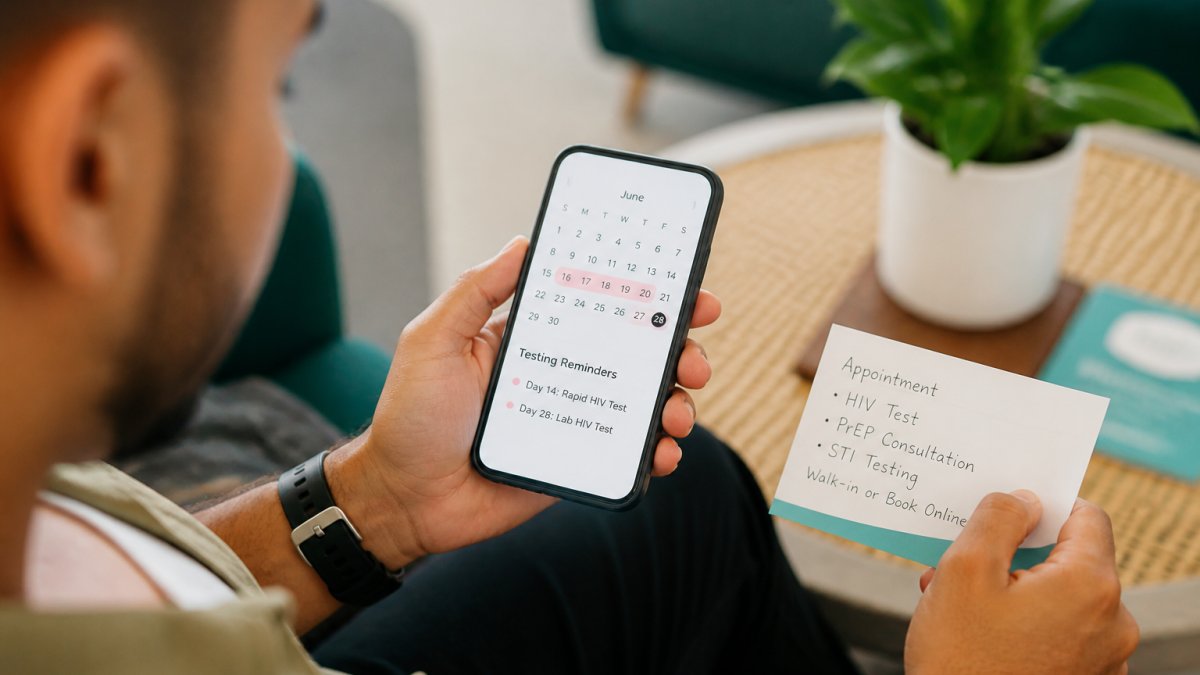
The 4th-generation lab test detects both antigens (virus pieces) and antibodies (immune response), making it more sensitive than rapid tests. It can detect HIV within the window period and is the gold standard for confirming results.
Starting PrEP requires a 4th-generation lab test (CDC rule). A rapid negative test is not enough; the lab test confirms you are truly HIV-negative.
4th-generation lab test advantages:
- Detects antigens and antibodies, not just one
- Closes the window period faster than rapid antibody tests
- Results are definitive after the window closes
- Required for PrEP initiation
- Confirms positive rapid test results
HIV Window Period Timeline: When to Test After Exposure
Test as soon as possible after exposure, then retest after the window closes. The first test establishes a baseline; the second test gives a definitive answer.
Testing timeline after exposure:
- Day 0-5: Early testing (antibody tests may be negative)
- Day 7-14: Lab test may detect antigen; rapid tests still may miss infection
- Day 18-21: Lab test is reliable for most people
- Day 45: Window closes; lab test is conclusive for nearly all infections
- After day 45: Negative result is definitive
At partner clinics across Miami-Dade and Broward, staff help patients understand this timeline.
PEP Treatment Window: Acting Fast After Exposure
Post-exposure prophylaxis (PEP) is emergency prevention taken after exposure. It must start within 72 hours to be effective. PEP is not the same as PrEP (which is taken before exposure). If you think you were exposed, go to an emergency room or urgent care immediately, do not wait.
How PEP works and when it's available
PEP uses antiretroviral drugs to block the virus from copying itself. It is available at emergency rooms and urgent care clinics. The 72-hour window is critical, waiting is risky.
PEP facts:
- Must start within 72 hours of exposure
- Taken for 28 days
- Highly effective if started early
- Available at emergency rooms and some clinics
- Requires HIV testing and baseline labs before starting
Rapid vs Lab Tests: What You Need to Know
Rapid tests give quick results but have a longer window period. Lab tests are more sensitive and are required for confirmation and PrEP. Both have a role: rapid tests for screening, lab tests for definitive answers.
Sensitivity and specificity: understanding accuracy
Sensitivity is the test's ability to detect HIV when it is present. A highly sensitive test catches most infections. Specificity is the test's ability to correctly identify someone who does not have HIV. A highly specific test rarely gives false positives.
| Test Type | Sensitivity | Specificity | Window Period |
|---|---|---|---|
| Rapid antibody | 85-99% | 98-99% | 18-45 days |
| 4th-gen lab (antigen/antibody) | 95-99% | 98-99% | 18-45 days |
| Lab nucleic acid test (RNA) | 99%+ | 99%+ | 10-14 days |
False negatives and false positives explained
A false negative occurs when a test says negative but HIV is actually present. This happens most often during the window period when viral load is high but antibodies have not yet developed. A false negative can give someone dangerous false reassurance.
Where to Get Tested in Miami-Dade and Broward
Testing for HIV is available at our partner clinics across Miami-Dade and Broward. All partner clinics offer walk-in testing, same-day results, and bilingual staff. Testing is free or low-cost; check with the clinic for details. No appointment is needed for rapid testing, though booking ahead can reduce wait times.
Partner clinics serving Miami-Dade:
Elite Wellness Club (Downtown Miami, 33130)
- Rapid HIV testing and 4th-generation lab confirmation
- Full STD panel, PrEP, and HIV care
- Serves Downtown, Brickell, Overtown (33130, 33131, 33129, 33132, 33136)
- Visit Elite Wellness Club
MedPlus Medical Center (Allapattah, 33142)
- Rapid HIV and lab testing
- Full STD panel, wellness visits
- Serves Allapattah, Liberty City, Little Havana, Wynwood (33142, 33125, 33127, 33147, 33150)
- Visit MedPlus Medical Center
MJD Wellness (North Miami, 33161)
- Rapid HIV and lab testing
- Full STD panel, wellness visits
- Serves North Miami, North Miami Beach, Biscayne Park (33161, 33162, 33181, 33168)
- Visit MJD Wellness
Anuvia Medical Center (North Miami, 33179)
- Rapid HIV and lab testing
- Full STD panel, PrEP consultation
- Serves North Miami, Aventura, North Miami Beach (33179, 33180, 33162, 33161)
- Visit Anuvia Medical Center
Miracles of the Heart (Kendall West, 33193)
- Rapid HIV and lab testing
- PrEP, STD testing and treatment
- Serves Kendall, West Kendall, The Hammocks, Tamiami (33193, 33186, 33196, 33184, 33183)
- Visit Miracles of the Heart
Survivors Pathways (Multiple locations)
- Rapid HIV and lab testing
- PrEP, STD testing, supportive services
- Serves across Miami-Dade and Broward
- Visit Survivors Pathways
Partner clinic serving Broward:
First Class OBGYN (Miramar, 33029)
- Rapid HIV and lab testing
- Full STD panel, PrEP (daily pill and every-2-month injection)
- HPV screening, telehealth-first PrEP visits
- Serves Miramar, Pembroke Pines, Hollywood, Davie, Cooper City, Weston (33029, 33027, 33025, 33023, 33028, 33024)
- Phone: 954-507-4494
- Visit First Class OBGYN
All partner clinics:
- Walk-ins accepted, same-day results
- English and Spanish
- Free or low-cost testing
- Book online or call 855-560-2280
Conclusion
Understanding the HIV window period and the difference between rapid and lab tests helps people make informed decisions about testing. Rapid tests are convenient but have a longer window period. Lab tests are more sensitive and close the window faster. After a potential exposure, testing as soon as possible, then retesting after the window closes, provides a definitive answer.
Frequently Asked Questions
How quickly does HIV show up on a rapid test?
Rapid tests detect HIV antibodies, which usually appear 18-45 days after exposure, though some people develop them faster. A rapid test can give results in minutes, but if you test too early in the window period, you may get a false negative. That's why retesting is important. At our partner clinics, we confirm rapid results with a lab test to be sure.
What should I do if I think I was exposed to HIV in the last 72 hours?
Post-exposure prophylaxis (PEP) can lower your risk if started within 72 hours of exposure. PEP is a short course of HIV medications taken for 28 days. You'll need a rapid HIV test to confirm you're negative before starting. Contact an emergency room or our partner clinics right away, Elite Wellness Club in Downtown Miami (33130) or First Class OBGYN in Miramar (33029) can help you get started today.
What's the difference between an antibody test and a 4th-generation antigen/antibody test?
An antibody test detects proteins your body makes to fight HIV, which takes 18-45 days to show up. A 4th-generation test detects both antibodies and antigens (pieces of the virus itself), so it can find HIV a few days earlier, around 18-45 days after exposure. Lab-based 4th-generation tests are more sensitive and are used to confirm rapid test results.
Can I get tested the same day at a clinic near me?
Yes. RapidTesting Miami partner clinics offer walk-in, same-day rapid HIV testing and lab tests. Use our Find a Clinic tool at rapidtestingmiami.com to locate the nearest clinic by zip code, check hours, and book online or call 855-560-2280. All partners provide free or low-cost testing and results in English and Spanish.
Find a clinic near you. Use RapidTesting Miami's Find a clinic tool to locate the nearest partner clinic by zip code, or book directly at any partner clinic above. All clinics offer walk-in testing, same-day results, and bilingual staff. Call 855-560-2280 with questions.
Need a test, a study, or a place to donate?
Free for patients · Walk-ins welcome · Bilingual EN/ES · Same-day rapid HIV results